
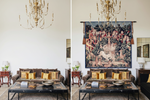
How to Decorate a Large Blank Wall: Why a Tapestry Beats Every Other Option
, Von heartcraft , 7 min Lesezeit
, Von heartcraft , 7 min Lesezeit
Every home has a large blank wall that's been waiting too long for the right solution. Gallery walls are a project. Canvas prints are flat. Mirrors are cold. A large tapestry is none of those things — and it does something no other wall treatment can: it makes a room feel genuinely alive. Here are five worth hanging.
You know the wall. It's too big for a single framed print, too prominent to ignore, and too important to get wrong. You've considered a gallery wall. You've looked at oversized canvas prints. You've thought about a mirror, a mural, a floating shelf arrangement...
Here's what you should actually do: hang a tapestry.
Not because it's the easiest option — though it is. Not because it's the most affordable — though it often is. But because a large tapestry does something that no other wall treatment can quite replicate: it makes a room feel genuinely alive.

Gallery walls look great in design magazines and take approximately forty-seven attempts to get right in real life. The measuring, the leveling, the inevitable moment when you realize the whole arrangement is two inches too far to the left — it's a project, not a solution. And when you eventually move...
Oversized canvas prints solve the scale problem but create a new one: they're flat. A large canvas print of a forest or a landscape sits on the wall like a photograph — which is essentially what it is. It has no texture, no depth, no quality of light that changes as the day changes. It looks the same at noon as it does at midnight.
Mirrors work beautifully in the right space, but they're a solution to a different problem — making a small room feel larger, bouncing light around a dark hallway. On a large feature wall in a living room or bedroom, a mirror can feel cold, impersonal, and slightly unsettling. You don't want to look up from your sofa and see yourself.
Wallpaper and murals are commitment. They require professional installation, they're expensive to change, and if you're renting — or if your taste evolves, as taste tends to do — you're stuck with them.
A large tapestry has none of these problems. It goes up with a rod and a few hooks. It comes down just as easily. It has texture, depth, and warmth that no flat surface can match. And it looks different — better — every time the light changes.

A tapestry isn't printed or painted — it's constructed, thread by thread, on a loom. The result is a surface with genuine physical depth: the warp and weft threads catch light at different angles, creating subtle variations in color and texture that shift as you move around the room, as the sun moves across the sky, as you switch from daylight to lamplight in the evening.
This is why tapestries have been used to decorate the walls of great houses, palaces, and castles for centuries. Not just because they were beautiful — though they were — but because they were warm, in every sense of the word. They insulated stone walls against the cold. They absorbed sound. They made large, formal rooms feel inhabited and human. They still do all of those things.

The question isn't whether to hang a tapestry. It's which one. Here are five that work particularly well on a large blank wall — each one different in mood, palette, and visual character, but all sharing the quality that matters most: presence.

2. 15th-Century The Unicorn Purifies Water Large Belgium Jacquard Tapestry
This is medieval tapestry at its most narrative and most beautiful. The unicorn — white, luminous, impossibly graceful — dips its horn into a stream while a group of hunters and noblemen look on from the forest's edge. The mille-fleurs background, dense with flowers and small animals, creates a surface so rich with detail that you'll find something new in it every time you look. On a large wall, it has the authority of a painting and the warmth of a textile. It suits a living room, a dining room, or any space where you want the room to feel like it has a story.

3. Gustav Klimt Watersnakes Belgian Jacquard Large Tapestry
Less well-known than The Kiss but, in many ways, more extraordinary. Two female figures drift through a dark, jewel-like underwater world, their hair flowing, their bodies surrounded by gold and pattern. The palette — deep teal, warm gold, rich brown — is both dramatic and deeply calming. In a bedroom, this tapestry creates a mood that's quietly mysterious and genuinely restful. In a living room or study, it makes a statement that's sophisticated without being cold.

4. Gustav Klimt's "Lady with a Fan" Large Belgian Jacquard Tapestry
One of Klimt's last great works, completed in the final year of his life. A woman holds a fan painted with birds and flowers, her figure surrounded by a riot of pattern and color — Chinese motifs, Japanese florals, Byzantine ornament, all compressed into a single extraordinary surface. The palette is perhaps the richest of all the Klimt tapestries: deep rose, warm gold, rich green, the dark background pressing in around the figure. In an entryway or dining room, this tapestry makes an immediate statement of cultivated, knowing beauty.

5. William Morris Owl & Willow Landscape Woven Tapestry Wall Hanging
For a large wall that needs warmth rather than drama, this William Morris landscape tapestry is the answer. The deep greens and earthy tones of the Morris palette create a room that feels grounded and calm — like being inside a forest rather than looking at one from outside. It works in a bedroom, a home office, or any space where you want the visual environment to restore rather than stimulate. The woven texture is particularly beautiful in natural light, where the threads catch and release the sun in a way that no printed surface can replicate.

Use a proper rod. A tapestry rod — either a wooden dowel or a metal curtain rod — distributes the weight evenly and keeps the tapestry hanging straight. Most tapestries come with a rod pocket or hanging loops at the top; if yours doesn't, tapestry clips work well and leave no marks on the fabric.
Get the height right. The center of the tapestry should be at roughly eye level — around 57 to 60 inches from the floor. If you're hanging it above a sofa or bed, leave 6 to 12 inches of space between the furniture and the bottom of the tapestry.
Let it be the focal point. A large tapestry is already doing a great deal of visual work. Resist the urge to surround it with other art or objects. Give it a clear wall, and let everything else in the room support it rather than compete with it.
Light it intentionally. A picture light mounted above the tapestry, or warm-toned wall sconces on either side, will bring out the depth and richness of the weave in a way that overhead lighting simply can't. The tapestry will look different — better — in the evening than it does in the middle of the day.

The large blank wall in your home isn't a problem. It's an opportunity — the largest canvas you have, waiting for something worthy of it. A large tapestry is worthy of it. It always has been.



$128.29 - $208.21


$158.06 - $198.24


$158.69 - $208.69


$96.28 - $125.68


