
William Morris to Modern Living: The Healing Power of Tapestries in Your Home Office
, by heartcraft , 3 min reading time
, by heartcraft , 3 min reading time
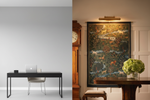
William Morris spent his life weaving nature into everyday spaces. Discover how his legacy — and a tapestry alive with horses, lions, and ancient forest — can transform your home office into a genuinely restorative place to work...
There's a reason we feel calmer in a forest than in a fluorescent-lit office. Nature doesn't just look beautiful — it actively restores us. And for centuries, artists have tried to bring that restoration indoors. No one did it more deliberately, or more beautifully, than William Morris.

Long before "biophilic design" became a buzzword, William Morris was weaving it into fabric. The 19th-century British designer and founder of the Arts and Crafts movement believed that the objects surrounding us shape how we feel — and that beauty was not a luxury, but a necessity of daily life.
His tapestries were dense with life: tangled vines climbing toward light, birds perched mid-song, deer pausing at the edge of a clearing, horses moving through ancient woodland. Every thread was intentional. Every creature placed with purpose. The result wasn't decoration — it was an environment. A world you could step into simply by looking.

That philosophy is the foundation of what we now call healing spaces — and it's more relevant to the modern home office than ever.
When you work from home, your environment is your office. And unlike a corporate building, you actually get to choose what surrounds you. Research in environmental psychology consistently shows that natural imagery — forests, animals, open landscapes — reduces stress hormones, lowers heart rate, and improves sustained attention.
A tapestry isn't just art on a wall. It's a sustained visual narrative. Your eye moves through it the way it moves through a real landscape: discovering a lion resting in dappled shade, following a white horse as it crosses a stream, tracing the arc of a branch heavy with leaves. That kind of slow, wandering attention is deeply restorative — the opposite of the sharp, depleting focus that screen work demands.

2026 Limited Edition Horse Tapestry
Look closely, and the forest reveals itself in layers. Ancient oaks spread wide canopies overhead, their bark textured and dark. Beneath them, wildflowers push through the undergrowth — white blooms catching light, green ferns curling at the edges of a winding stream. The water moves through the scene like a quiet thread of silver, connecting meadow to woodland, shadow to sun.
And then there are the animals. A lion — golden, unhurried — stands at the forest's edge, surveying the scene with the calm authority of something that has never needed to rush. Nearby, a white horse moves through the clearing with fluid grace, its coat luminous against the deep greens of the canopy. These aren't decorative motifs. They're characters in a story that has been unfolding for centuries — the story of wild things living in harmony with the land.
Hung in your home office, this tapestry doesn't just fill a wall. It opens one.

Hang it where your eyes naturally rest. The tapestry should be in your sightline when you look up from your screen — not behind you, not off to the side, but directly in the path of your gaze when you pause to think.

Pair it with warm, indirect light. A brass wall sconce or a warm-toned floor lamp will bring out the tapestry's earthy greens and golds, creating the quality of light you'd find in a woodland clearing at golden hour.
Use it as a reset anchor. When you feel the pull of distraction or the weight of a difficult task, look at the tapestry for sixty seconds. Find the horse. Find the lion. Follow the stream. Let your nervous system remember what calm feels like.
2026 Limited Edition Horse Tapestry
William Morris spent his life arguing that beautiful things should be part of everyday life, not reserved for museums or the very rich. This tapestry is made in that spirit: a piece of living art, designed to hang where you work, breathe, and think — and to remind you, every time you look up, that the world is larger and quieter than your inbox suggests.



$128.29 - $208.21


$128.06 - $178.24


$135.69 - $170.69


$96.28 - $125.68


