
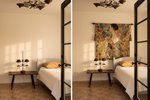
Gustav Klimt Tapestry: Bringing Art Nouveau's Golden Autumn Into Your Home
, by heartcraft , 6 min reading time
, by heartcraft , 6 min reading time
Gustav Klimt's gold, his deep jewel tones, his sense of beauty on the edge of impermanence — it's all autumn, translated into art. Discover why a large Klimt tapestry is the most natural thing you can hang on your wall this fall, and how to style it for maximum warmth and impact.
Klimt's gold is not decorative. It's elemental. In his greatest works — The Kiss, Water Serpents, Lady with a Fan — gold leaf and gold paint don't just illuminate the surface. They transform it, turning human figures into something between the earthly and the divine. It's the same transformation that autumn performs on the landscape every year: taking the ordinary and making it briefly, heartbreakingly beautiful.
This is why a Klimt tapestry belongs in your home in autumn more than at any other time of year. The colors are already there. The mood is already there. All you have to do is hang it.

Gustav Klimt (1862–1918) was the leading figure of the Vienna Secession — the Austrian art movement that broke from academic tradition at the end of the 19th century in pursuit of a new, total art form that would dissolve the boundaries between fine art and decorative art, between painting and craft, between the beautiful and the meaningful.
The movement's motto was Der Zeit ihre Kunst, der Kunst ihre Freiheit — "To every age its art, to art its freedom." For Klimt, that freedom meant gold. It meant pattern. It meant the human body rendered in mosaic-like fragments of color and texture, surrounded by ornament so dense and intricate that it becomes its own kind of landscape.
The palette he returned to again and again — deep gold, warm copper, rich burgundy, forest green, the occasional shock of cobalt blue — is, almost exactly, the palette of an autumn afternoon. This is not a coincidence. Klimt was deeply influenced by Byzantine mosaics, Japanese decorative art, and the natural world, all of which share autumn's tendency toward richness, warmth, and the kind of beauty that feels slightly too good to last.
The Kiss by Gustav Klimt Large Belgium Jacquard Tapestry is the most iconic image in the Klimt canon — and one of the most recognized paintings in the world. Two figures, wrapped in gold and pattern, locked in an embrace at the edge of a flowering meadow. The gold of their robes catches the light the way autumn leaves do: warmly, generously, as if the light itself is a kind of love.
In a living room, hung above a sofa or fireplace, The Kiss creates an immediate sense of warmth and intimacy. Pair it with deep jewel-toned cushions — burgundy, forest green, warm amber — and the room will feel like the inside of an autumn afternoon. It's the kind of image that makes people stop when they walk into a room. It's been doing that for over a hundred years.

The Gustav Klimt Watersnakes Belgian Jacquard Large Tapestry is less well-known than The Kiss, but in many ways more extraordinary. Two female figures drift through a dark, jewel-like underwater world — their hair flowing, their bodies surrounded by gold and pattern, the whole scene suspended between dream and reality.
The colors — deep teal, warm gold, rich brown, the occasional flash of copper — are autumn colors translated into water. In a bedroom, this tapestry creates a mood that's both deeply calm and quietly mysterious: the feeling of being submerged in something beautiful, insulated from the noise of the world outside. It's exactly the mood you want in a bedroom as the days get shorter and the evenings longer.
The Gustav Klimt "Lady with a Fan" Large Belgian Jacquard Tapestry is one of Klimt's last great works, completed in the final year of his life. A woman holds a fan painted with birds and flowers, her figure surrounded by a riot of pattern and color — Chinese motifs, Japanese florals, the dense ornament of Byzantine art, all compressed into a single, extraordinary surface.
The palette here is perhaps the most autumnal of all: deep rose, warm gold, rich green, the dark background pressing in around the figure like the early dark of an October evening. In a dining room or entryway, this tapestry makes an immediate statement — not just of beauty, but of a particular kind of cultivated, knowing beauty that understands its own history.

There's a reason we associate autumn with art. The season has always been associated with harvest, abundance, and the particular pleasure of beautiful things that don't last. The Japanese have a word for it — mono no aware, the bittersweet awareness of impermanence — and Klimt's art is saturated with exactly this feeling.
His figures are always on the edge of something: the edge of a meadow, the edge of sleep, the edge of a moment that is about to pass. His gold is always slightly too bright, his patterns always slightly too dense, his beauty always slightly too much — which is exactly what makes it feel true. Autumn is like that too.
A Klimt tapestry in your home in autumn isn't just decoration. It's a way of paying attention to the season — of acknowledging that the light is changing, that the year is turning, that beauty is most beautiful when you know it won't last forever.
Pull the gold into the room. Klimt's gold is the starting point for your autumn palette. Brass candlesticks, amber glass, honey-colored wood, warm-toned ceramics — any of these will echo the tapestry's warmth without competing with it.
Go deep with textiles. Autumn is the season for layering. Add cushions and throws in burgundy, forest green, deep teal, or warm terracotta — colors that appear in the tapestry and that deepen the room's sense of warmth and enclosure.
Light it warmly. Klimt's gold responds to warm light the way it responds to autumn sun: it glows. Use warm-toned bulbs (2700K or lower), and consider a picture light mounted above the tapestry to bring out the depth of the weave.
Keep the wall clear. A large Klimt tapestry is already doing an enormous amount of visual work. Give it a clear wall, without competing art or objects, and let it be the room's focal point. Everything else should support it, not rival it.

Klimt spent his career arguing, through his art, that beauty was not a luxury — that it was, in fact, a necessity of human life, as essential as food or shelter or love. The Vienna Secession's great project was to bring that beauty into everyday spaces: not just museums and galleries, but homes, apartments, the rooms where people actually lived.
A Klimt tapestry is that project made tangible. It's a large-format work of art, woven in Belgian Jacquard, designed to hang in the room where you spend your evenings — to be looked at over dinner, noticed from across the room, lived with through the long, golden weeks of autumn.



$128.29 - $208.21


$158.06 - $198.24


$158.69 - $208.69


$96.28 - $125.68


