
The Landscape Tapestry as Apartment Wall Decor: Why Forest Scenes Belong in Every Room
, Von heartcraft , 5 min Lesezeit
, Von heartcraft , 5 min Lesezeit
We spend more time indoors than ever — and our walls pay the price. Discover the environmental psychology behind why forest landscape tapestries actively restore focus, calm, and wellbeing, and how a Belgium Jacquard verdure tapestry can transform every room in your apartment.
We spend more time indoors than any generation before us. We work indoors, rest indoors, socialize indoors — and increasingly, we're aware of what that costs us. The research is consistent: time in nature reduces stress, lowers blood pressure, improves mood, and restores the kind of diffuse, open attention that focused screen work depletes. The problem, for most apartment dwellers, is that nature isn't always accessible.
This is where a landscape tapestry does something quietly remarkable. It doesn't replace a walk in the forest. But it does something a blank wall, a framed print, or a painted accent wall cannot: it brings the forest inside, in a form that's textured, layered, and visually alive enough to actually work on the nervous system.

Attention Restoration Theory, developed by environmental psychologists Rachel and Stephen Kaplan, proposes that natural environments restore mental fatigue through four key qualities: a sense of being away, extent (the feeling of being in a whole other world), fascination (effortless, involuntary attention), and compatibility (the environment supports what you want to do).
A well-chosen landscape tapestry delivers all four. The forest scene creates a sense of being away from the demands of the room. Its depth and detail — the layered canopy, the winding path, the birds half-hidden in the foliage — create the feeling of extent, of a world that extends beyond the frame. Its visual richness generates fascination: your eye moves through it the way it moves through a real landscape, discovering something new each time. And its warmth and beauty are compatible with almost any activity — working, resting, eating, thinking.

This is why verdure tapestries — the lush, forest-and-garden landscape tapestries that originated in the Flemish workshops of the 15th century — have never really gone out of fashion. They work. Not just aesthetically, but psychologically.
The living room: your daily reset. The living room is where you decompress after work, where you host friends, where you spend the hours between the demands of the day. A landscape tapestry on the main wall of a living room creates a constant, low-level restorative effect — the visual equivalent of leaving a window open onto a garden. You don't have to look at it deliberately. It works in your peripheral vision, softening the room and anchoring it in something natural.

The bedroom: sleep better, wake calmer. The last thing you see before you sleep and the first thing you see when you wake matters more than most people realize. A forest scene — with its associations of shelter, abundance, and the slow rhythms of the natural world — is one of the most sleep-compatible images you can put on a bedroom wall. It signals to the nervous system that this is a place of rest, not performance.

The home office: protect your focus. Cognitive fatigue is real, and it accumulates faster than we notice. A landscape tapestry in your home office gives your eyes somewhere to rest between tasks — a brief, involuntary excursion into a world that makes no demands. Research suggests that even 40 seconds of looking at a natural scene is enough to begin restoring directed attention. A tapestry makes that 40 seconds available every time you look up from your screen.

The dining room: slow down and taste. Meals eaten in beautiful, calm environments are more enjoyable and more nourishing — not just psychologically, but physiologically. The parasympathetic nervous system (the "rest and digest" mode) functions better when we're relaxed. A landscape tapestry in a dining room creates the conditions for that relaxation, turning an ordinary meal into something closer to a ritual.

Not all landscape wall art delivers these effects equally. A printed poster of a forest is not the same as a woven one. The difference is texture, depth, and the quality of attention the object itself commands.
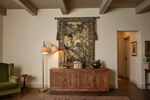
The 17th-Century Verdure Royal Gardens Medieval Belgium Jacquard Tapestry is woven using the Jacquard loom technique — the same method that has produced Belgium's finest tapestries for centuries. The result is a piece with genuine visual depth: the colors shift slightly as the light changes, the weave catches and releases light in a way that flat printed surfaces cannot, and the layered detail of the forest scene — the dense canopy, the flowering undergrowth, the birds and animals moving through the scene — rewards the kind of slow, wandering attention that restores rather than depletes.

It's also, simply, beautiful. The warm greens and golds of the verdure palette work with almost any interior color scheme. The ornate border frames the scene with the authority of a painting. And the scale — large enough to fill a wall, substantial enough to anchor a room — means it does its restorative work without you having to think about it.
Apartment living involves a series of compromises: less space, less light, less access to the outdoors. A landscape tapestry doesn't solve all of those compromises. But it addresses one of the most significant — the absence of nature from the visual environment — in a way that's immediate, beautiful, and surprisingly effective.
The forest has always been where humans go to recover. A verdure tapestry brings the forest to you.



$128.29 - $208.21


$128.06 - $178.24


$135.69 - $170.69


$96.28 - $125.68


