
Unlocking Medieval Symbolism: What the Knights and Horses in the Bayeux Tapestry Really Mean
, Von heartcraft , 4 min Lesezeit
, Von heartcraft , 4 min Lesezeit
The knights and warhorses depicted in the Bayeux Tapestry serve as a hidden code of the Middle Ages, symbolizing absolute power, the ruling elite, and the birth of European chivalry. The warhorses represent the ultimate in luxury and military dominance, while the knights embody divine authority and the nascent code of chivalric honor....
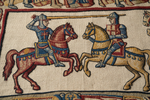
In the 11th-century Bayeux Tapestry, the knights and horses are not mere battle decorations—they are a sophisticated medieval code for absolute power, elite status, and the birth of European chivalry. Specifically, the majestic warhorses (Destriers) symbolize the ultimate luxury asset and military dominance of the ruling class, while the heavily armored knights represent protection, divine authority, and a shifting tide of martial honor.
In an era before printing presses or widespread literacy, this legendary 70-meter textile masterpiece functioned as the ultimate visual narrative of the 1066 Norman Conquest. By decoding the hidden language of these two iconic motifs, we can understand how ancient storytelling seamlessly bridges into a modern statement of heritage for your living space. Let’s dive deeper into what these symbols truly mean.

In the 11th century, a horse was not just a means of transport; it was the equivalent of a modern supercar, a tactical tank, and a high-status luxury asset all rolled into one.
The Norman horses depicted in the tapestry are Destriers—highly trained, powerfully built warhorses bred specifically for heavy shock cavalry charges.
The Power Dynamics: Look closely at how the horses are rendered. Their arched necks, muscular hindquarters, and dynamic, forward-leaning stances symbolize unstoppable power, momentum, and divine right.
The Language of Color: You might notice that the horses in the tapestry are embroidered in surprising shades—some are blue, others red, green, or yellow. While partly due to the limited palette of dyed wool available to medieval artisans, historians believe this shifting coloration was also used to create depth, indicate different ranks, or highlight the chaotic intensity of the battlefield.
When you feature a tapestry with these majestic creatures on your wall, you are introducing a timeless symbol of nobility, vitality, and driven ambition into your home.

The knights in the Bayeux Tapestry represent the absolute pinnacle of the medieval warrior class. They are captured at a pivotal moment in history—the exact era when the idealized Chivalric Code (the rules of honor, bravery, and loyalty) was beginning to solidify across Europe.
Key symbols attached to the knights include:
The Chainmail (Hauberk): The knee-length shirts of interlocking iron rings were incredibly expensive to produce. Wearing a hauberk immediately signaled that the wearer belonged to the wealthy ruling elite.
The Kite Shield: The long, almond-shaped shields carried by the Norman knights were a cutting-edge military innovation of the 11th century, designed to protect a rider's entire left flank while on horseback.
In the tapestry, the knight represents structure, protection, and focused strength. It’s an archetype that speaks of heritage, historical resilience, and an unwavering commitment to one's path.

The original Bayeux Tapestry is a massive horizontal band stretching nearly 70 meters long—making it nearly impossible to display in a standard modern home.
By carefully curating the most iconic segment—the charging knight and his fierce warhorse—and re-imagining it into a vertical composition, the chaotic energy of the 1066 battlefield is transformed into a balanced, grounded piece of interior art.
Hanging a vertical, Jacquard-woven historical tapestry creates a rich aesthetic anchor. It fits perfectly into a study, a quiet reading corner, or a home office, instantly establishing what designers call a "Conversation Starter." It signals a love for history, an appreciation for textile heritage, and a desire to infuse busy modern lives with the quiet, grounded weight of centuries past.

You don’t need to visit a museum in Normandy to feel the romance of the medieval era.
The HeartCraft 2026 Horse Bayeux Vertical Jacquard Tapestry captures the intricate detail, rich symbolism, and touchable texture of the original 11th-century masterpiece. Woven with premium fibers to honor ancient craftsmanship, its elegant vertical layout is engineered specifically to breathe life, warmth, and historical depth into your narrow walls and quiet spaces.

👉 [Explore the HeartCraft Bayeux Knight & Horse Tapestry Today] (Limited seasonal stock available).



$128.29 - $208.21


$158.06 - $198.24


$158.69 - $208.69


$96.28 - $125.68


