
Peacock Feather Meaning in Art History: From Ancient Rome to Your Wall
, Von heartcraft , 5 min Lesezeit
, Von heartcraft , 5 min Lesezeit
The peacock feather's "eye" pattern has appeared on walls, textiles, and manuscripts for more than two thousand years — carrying meanings of immortality, paradise, divine protection, and beauty across Roman, Byzantine, Islamic, medieval, and Victorian art. Here's the full story, and why it still belongs on your wall.
There is a pattern that has appeared on walls, floors, textiles, and manuscripts for more than two thousand years. It looks like an eye — a dark pupil surrounded by rings of blue, green, and gold, fringed with the delicate barbs of a feather. You know it immediately. It's the eye of a peacock feather.
What's remarkable is not just how beautiful it is, but how consistently it has meant something. Across cultures, centuries, and continents, the peacock feather has carried a weight of symbolism that almost no other natural pattern can match. Here's the story of how it got there — and why it still belongs on your wall.

The Romans inherited the peacock from the Greeks, who associated it with Hera — queen of the gods, goddess of marriage and sovereignty. But it was the Romans who gave the peacock feather its most enduring symbolic role.
In Roman funerary art, the peacock was a symbol of apotheosis — the transformation of a mortal into a divine being after death. When an emperor died, a peacock was released at his funeral pyre, its flight skyward representing the soul's ascent to the heavens. The "eyes" in the feathers were understood as the eyes of the stars — the watchful gaze of the divine looking down on the world below.
This is why peacocks appear so frequently in Roman mosaics, sarcophagi, and tomb paintings. They weren't decorative. They were guardians — the eyes of eternity, keeping watch over the boundary between the living and the dead.
When Christianity spread through the Roman Empire, it absorbed the peacock's symbolism rather than discarding it. The early Church found in the peacock a perfect emblem of resurrection and eternal life — partly because of the Roman association with apotheosis, and partly because of a widespread belief, inherited from ancient natural history, that peacock flesh did not decay after death.
This belief — almost certainly false, but deeply held — made the peacock an irresistible symbol for a religion centered on the promise of bodily resurrection. Peacocks appear in the catacombs of Rome, in the apse mosaics of early Byzantine churches, in the illuminated margins of medieval manuscripts. The "eyes" of the feathers were read as the all-seeing eye of God — omniscient, protective, and eternal.
In this context, a peacock feather wasn't just beautiful. It was a statement of faith: a reminder, woven or painted or carved into the fabric of daily life, that death was not the end.

In Islamic art and architecture, the peacock became associated with paradise — the garden of eternal life described in the Quran. The bird's extraordinary plumage, with its seemingly impossible colors and its symmetrical "eye" patterns, was understood as a glimpse of divine beauty: a foretaste of the perfection that awaited the faithful.
Peacocks appear throughout Islamic decorative art — in tilework, in manuscript illumination, in the carved stucco of Moorish palaces. The feather's "eye" pattern was abstracted into geometric forms that became foundational to Islamic ornament: the arabesque, the medallion, the endlessly repeating pattern that suggests infinity without ever depicting it directly.
This is one of the great hidden stories of art history: that the geometric patterns we associate with Islamic decoration are, in part, a translation of the peacock feather into the language of mathematics. The eye became a circle. The circle became a medallion. The medallion became a cosmos.
By the medieval period, the peacock had acquired a more ambiguous reputation in European culture. On one hand, it remained a symbol of beauty, nobility, and divine grace. On the other, its habit of displaying its feathers was read as a cautionary emblem of pride — the sin that, in Christian theology, preceded all others.
This tension made the peacock endlessly interesting to medieval artists and moralists. It appeared in bestiaries — the illustrated encyclopedias of animals that served as moral guides — as a creature of contradictions: beautiful but vain, its magnificent exterior concealing ugly feet and a harsh, discordant cry. The lesson was clear: appearances deceive. True beauty is inward.
And yet the peacock remained a symbol of aristocratic aspiration. At medieval banquets, a roasted peacock — re-dressed in its own feathers — was the most prestigious dish that could be served. Knights swore their most solemn vows "on the peacock." The bird's feathers decorated helmets, banners, and the margins of illuminated manuscripts. Whatever the moralists said, the peacock was magnificent, and everyone knew it.
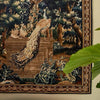
It was in this context that the great Flemish tapestry workshops began weaving peacocks into their verdure landscapes — placing the bird beside fountains, in enclosed gardens, among the flowers and animals of an idealized natural world. The 17th-Century Flemish Verdure Tapestry — Peacock & Fountain stands in this tradition: a peacock in paradise, its feathers displayed, its symbolism intact after four hundred years.

Two thousand years of art history have tested the peacock feather against every change of taste, every shift in culture, every revolution in style. It has survived all of them. The reason, ultimately, is simple: the pattern is extraordinary. The concentric rings of color, the symmetry of the "eye," the way the barbs catch light and seem to shift between blue and green depending on the angle — these are qualities that human beings respond to instinctively, across cultures and centuries.
When you hang a peacock tapestry on your wall, you're participating in a tradition that stretches back to Roman mosaics and Byzantine churches, to medieval banquets and Flemish weaving workshops, to Whistler's gilded dining room and Morris's patient looms. You're bringing into your home a pattern that has meant something — immortality, paradise, beauty, protection, grace — for as long as people have been making art.

Explore the 17th-Century Flemish Verdure Tapestry — Peacock & Fountain and the Peacock & Fountain Tapestry Cushion — two ways to bring this two-thousand-year tradition into your home, at whatever scale feels right.



$128.29 - $208.21


$158.06 - $198.24


$158.69 - $208.69


$96.28 - $125.68


