
Gobelin & Jacquard: How Two Legendary Weaving Traditions Are Reshaping Modern Home Aesthetics
, Von heartcraft , 7 min Lesezeit
, Von heartcraft , 7 min Lesezeit
From Louis XIV's royal atelier to Jacquard's mechanical revolution, Gobelin and Jacquard weaving together wrote the most luminous chapter in European textile art. This essay traces the origins of both traditions and explores how eighteenth-century Rococo tapestries after Boucher are finding new life in the contemporary home.
A tapestry is time made tangible. When you stand before one, what you perceive is not merely pattern and colour — it is the concentrated devotion of a craftsman who, centuries ago, bent over a loom and drew each weft thread through with quiet, unhurried precision.
In the long lineage of European textile art, two names shine like twin stars: Gobelin and Jacquard. Born in different centuries, they nonetheless share a common ambition — to weave humanity's longing for beauty into cloth that endures.
The Gobelin tradition traces its origins to Paris in 1662, when Jean-Baptiste Colbert, finance minister to Louis XIV, transformed a venerable dyeing workshop on the Left Bank — the family enterprise of the Gobelins — into the Manufacture Royale des Gobelins. From that moment, the atelier became the supreme court of European textile art, producing works exclusively for Versailles and the royal houses of the continent: objects that were simultaneously instruments of power and monuments to taste.
The essence of Gobelin weaving lies in pure hand-weft technique. The weaver works with his back to the cartoon, facing the reverse of the loom, drawing coloured weft threads row by row through the warp according to a mirror image of the design. Within a single square centimetre, dozens of threads may interlock — yielding a chromatic depth and luminosity that rivals oil on canvas. A large Gobelin tapestry may occupy several master weavers for years. Time itself is woven into the cloth.
The Jacquard loom arrived roughly a century and a half later. In 1804, the Lyon inventor Joseph-Marie Jacquard devised a mechanism by which punched cards controlled the raising and lowering of individual warp threads, enabling the mechanical reproduction of complex patterns. The implications extended far beyond the textile workshop: the binary logic embedded in those punched cards would later inspire the foundational principles of modern computing.
One craft represents the irreducible supremacy of the hand; the other, the precision of the machine and the democratisation of beauty. Yet their ultimate aspiration has never diverged: to fix the human desire for beauty permanently into woven form.
If the seventeenth century was the founding era of Gobelin weaving, the eighteenth was its golden age — a period in which the Rococo swept the courts of Europe and aesthetic ambition reached its most exquisite pitch.
No figure embodied the spirit of that age more completely than François Boucher, Premier Painter to Louis XV. His pastoral scenes — skies of rose and gold, shepherdesses at play among climbing roses, borders of acanthus wrought with lapidary care — defined the visual language of an era. These compositions were translated in great numbers into Gobelin cartoons, and the resulting tapestries hung in the Hall of Mirrors at Versailles and in the salons of aristocrats across the continent.
Such works retain their power to arrest the breath even today.

▲ Rococo Dream: The Boucher Royal Collection | Museum-quality handwoven tapestry in natural fibres with hand-embroidered details. Boucher's pastoral poetry lives on in every interlaced weft thread. The rose-and-gold palette and intricate botanical motifs represent the highest expression of eighteenth-century French court taste.
HeartCraft's Rococo Dream: The Boucher Royal Collection is a homage of the deepest sincerity to that vanished world. Woven by hand in natural fibres and enriched with fine hand embroidery, this museum-grade tapestry carries the elegance of the French court into the contemporary interior — not as pastiche, but as living tradition.

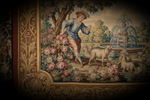
▲ 18th-Century Rococo French Woven Tapestry — The Musician Shepherd | 84 × 64 cm, cotton and wool blend, after Boucher's La Noble Pastorale series. Within its acanthus border, the shepherd stands at ease, his flute raised, as though time itself has paused to listen. This is an unrepeatable object — the last whisper of a court civilisation that the Revolution swept away.
A still rarer piece in the HeartCraft collection — the 18th-Century Rococo French Woven Tapestry: The Musician Shepherd — is a genuine antique of singular importance. This 84 × 64 cm cotton-and-wool tapestry derives from Boucher's La Noble Pastorale series and depicts the celebrated Flute Player within a classical acanthus border. Historians remind us that the Rococo fell swiftly from favour after the French Revolution; tapestries such as this are among the last material witnesses to that lost golden age. There will never be another quite like it.
The advent of the Jacquard loom in the nineteenth century was not a usurpation of the handcraft tradition — it was a profoundly humanist act of democratisation.
Before the Jacquard mechanism, the production of complex woven patterns depended entirely on intensive hand labour and was priced accordingly: only royalty and the high aristocracy could afford such things. The Jacquard loom, by mechanising the control of individual warp threads, made it possible to reproduce intricate geometric ornament, floral compositions, and even figurative scenes at scale — with undiminished quality, but within reach of a far wider public.
It was, in its quiet way, a revolution. Beauty was no longer the exclusive property of power.
Modern digital Jacquard technology has carried this logic further still. It can faithfully reconstruct historical patterns of extraordinary complexity — medieval verdure, Renaissance mythologies, Rococo pastorals — and reintroduce them into the contemporary home with a fidelity that would have astonished the original weavers. This is the animating conviction of HeartCraft: to use the craft of the present as a vessel for the beauty of the past.
For those who wish to acquire a tapestry with genuine discernment, understanding the essential distinction between these two traditions is the necessary first step.
| Gobelin Hand-Woven Tapestry | Jacquard Woven Tapestry | |
|---|---|---|
| Method | Pure hand-weft weaving | Mechanical / digital loom |
| Production time | Months to years | Hours to days |
| Pictorial depth | Exceptional — approaches oil painting | High — suited to geometric and repeat patterns |
| Value proposition | Works of art for collecting and inheritance | Fine decorative objects for daily life |
Neither tradition is superior to the other; they answer different needs and different sensibilities. If you seek an object that may be passed from generation to generation as a work of art, the hand-woven tapestry is without rival. If you wish to bring the aesthetic weight of history into your daily surroundings at a considered price, the Jacquard tapestry offers an eminently civilised solution.
Whether one thinks of the Gobelin weavers of the seventeenth century, bent over their looms in the lamplight of the Faubourg Saint-Marcel, or the Jacquard operators of nineteenth-century Lyon threading their punched cards with methodical care, their conviction was identical: beauty is worth preserving permanently.
When a tapestry is hung upon a wall, what changes is not merely the visual field — it is the entire atmosphere of the room. A bare wall acquires a narrative; a modern interior acquires historical depth and human warmth.
That, in the end, is why the art of weaving has retained its power to move us across so many centuries.
Explore HeartCraft's eighteenth-century Rococo tapestry collection, and allow the aesthetic of the court to become part of your everyday life.



$128.29 - $208.21


$158.06 - $198.24


$158.69 - $208.69


$96.28 - $125.68


